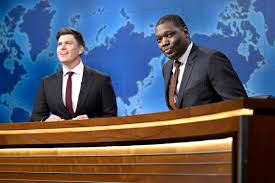
For years now, one of the most reliably chaotic, uncomfortable, and irresistibly funny moments on “Saturday Night Live” has arrived not through elaborate sketches or celebrity cameos, but through a simple premise at the “Weekend Update” desk: Colin Jost and Michael Che reading jokes they did not write. The joke swap has become less of a segment and more of an event, something viewers brace themselves for with equal parts anticipation and dread. By the time the final episode of 2025 rolled around, fans expected fireworks. What they got was something even more unhinged—a one-sided ambush that pushed the tradition into new territory and reminded everyone why this bit still hits so hard after all these years.
At its core, the joke swap works because it weaponizes trust. Jost and Che are co-anchors, collaborators, and longtime comedic partners who have spent years building chemistry on live television. When one of them hands the other a joke to read, that trust is immediately broken for the sake of comedy. The audience knows exactly what’s coming: a line so outrageous, so inappropriate, or so personally damaging that the reader would never willingly say it on air. The laughter doesn’t just come from the joke itself, but from the visible discomfort, the nervous chuckles, the slight pauses where the anchor considers whether this is really happening.
In the 2025 season finale, Che decided to twist the knife even deeper. Instead of the usual back-and-forth exchange of mutually assured embarrassment, he revealed that he alone had written the jokes. Jost, visibly caught off guard, pointed out that Che had explicitly told him they weren’t doing the bit this year. Whether Jost’s surprise was genuine or part of the performance hardly mattered. The setup immediately shifted the power dynamic. This wasn’t a duel anymore; it was an execution.
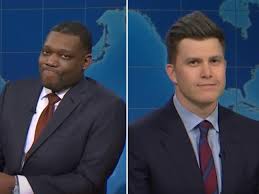
What followed was a segment designed entirely around forcing Jost into saying things no “SNL” anchor—especially one with his clean-cut, Harvard-grad persona—would ever choose to say. The jokes themselves went straight for historically and socially radioactive subjects, including slavery and church sexual abuse, areas where comedy becomes a high-wire act even under the best circumstances. Jost’s delivery, stiff and visibly uneasy, became part of the punchline. Each joke landed not just because of its shock value, but because the audience could see Jost grappling with the words as they left his mouth.
Then came the personal stuff, which is where the joke swap has always found its most potent fuel. Jost’s marriage to Scarlett Johansson has long been an irresistible target, not only because she’s one of the most famous actors in the world, but because Jost himself has leaned into the absurdity of that pairing. Che knows this, and he exploited it mercilessly. The menopause joke, paired with Johansson’s photo on screen, pushed the bit into deeply uncomfortable territory, blending celebrity culture, aging anxieties, and marital intimacy into a single, cringeworthy moment. Jost’s forced delivery—particularly the exaggerated, profane punchline—felt like watching someone read their own roast under duress.
Just when it seemed like the segment couldn’t escalate further, Che dropped the final bomb: the “backup” plan. The sudden appearance of Jenna Ortega’s image, combined with a joke that hinged on both her age and sexual innuendo, jolted the audience into that familiar mix of laughter and disbelief. It was the kind of line that makes viewers gasp before they laugh, instinctively checking themselves for enjoying something so wrong. Jost’s expression said it all. He wasn’t just uncomfortable; he looked genuinely stunned by how far Che was willing to go.
This is where the joke swap distinguishes itself from other edgy comedy. The jokes are outrageous, yes, but the real spectacle is watching the anchors react in real time. Jost’s discomfort, Che’s barely contained glee, and the audience’s collective “did he really just say that?” energy combine into something uniquely live and electric. It’s not polished. It’s not safe. And that’s exactly why it works.
The 2025 finale also served as a reminder of how long this tradition has been evolving. What started as a clever twist on “Weekend Update” has grown into an annual ritual, typically reserved for Christmas episodes and season finales. Over time, the stakes have increased. Each year, the jokes get riskier, the personal attacks sharper, and the reactions more extreme. It’s an arms race of embarrassment, with Jost and Che constantly trying to outdo their past selves.
Last year’s Christmas episode set a particularly high bar when Che forced Jost to read a vulgar joke about Johansson—while Johansson herself was in the building. The decision to cut to her reaction was a masterstroke of television, transforming the segment from a simple joke swap into a meta-commentary on celebrity, marriage, and public humiliation. Johansson’s shocked expression became instantly iconic, a visual representation of what happens when private relationships collide with live comedy.

Jost didn’t let that moment slide. During the Season 50 finale earlier this year, he orchestrated his own revenge by making Che read an apology to Johansson at the “Weekend Update” desk. Bringing Johansson out for that segment flipped the script. Suddenly, Che was the one squirming, forced to deliver a self-deprecating, deeply inappropriate monologue that leaned into his own insecurities for laughs. The line about never having seen a “human vagina,” followed by the farm reference, was classic Che—absurd, shocking, and delivered with a straight face that made it even more outrageous.
Taken together, these moments tell a larger story about why Jost and Che’s partnership has endured. On paper, they couldn’t be more different. Jost often plays the buttoned-up, all-American newsman, while Che leans into a sharper, more confrontational comedic style. The joke swap allows them to weaponize those differences, forcing each other into comedic territory that clashes violently with their public personas. Watching Jost deliver a joke that sounds like it belongs in Che’s voice, or vice versa, creates a dissonance that audiences can’t get enough of.
There’s also something refreshingly honest about how far they’re willing to push each other. In an era where comedy is often scrutinized, dissected, and debated in real time on social media, the joke swap feels like a controlled explosion. It acknowledges the boundaries of good taste by deliberately crossing them, then invites the audience to sit with the discomfort. The laughter isn’t always clean or easy, but it’s real.
The 2025 finale’s one-sided twist amplified that feeling. By removing Jost’s ability to retaliate in the moment, Che turned the segment into a study in power and vulnerability. Jost wasn’t just participating; he was enduring. That imbalance made every joke hit harder, because there was no immediate release valve, no chance for Jost to fire back. The audience knew Che was enjoying every second of it, and that knowledge made the discomfort even funnier.
Of course, part of what makes the joke swap palatable is the understanding that Jost and Che genuinely trust each other off-camera. The cruelty is performative, the insults exaggerated for effect. Without that underlying bond, the segment would feel mean-spirited instead of mischievous. Instead, it plays like an extreme version of friends roasting each other, only with millions of viewers watching and the stakes multiplied by fame, reputation, and live television.
As “SNL” continues to evolve, bits like the joke swap serve as reminders of what the show does best when it’s firing on all cylinders. It takes simple ideas and pushes them to their breaking point, relying on timing, chemistry, and a willingness to embrace risk. Not every joke lands. Some make viewers uncomfortable in ways they’re not sure they enjoy. But that tension—the space between laughter and shock—is where the segment lives.
By the end of the 2025 finale, it was clear that Jost and Che’s most shocking tradition is still very much alive. If anything, it’s grown bolder, more self-aware, and more willing to flirt with disaster. The one-sided ambush may have left Jost visibly shaken, but it also delivered one of the season’s most talked-about moments. And as long as these two keep trusting each other enough to cross every imaginable line, audiences will keep tuning in, bracing themselves for whatever comes next.