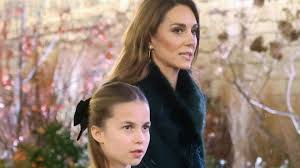
Princess Kate delivered a quietly powerful and deeply personal moment this Christmas Eve, one that blended music, motherhood and meaning in a way that felt intimate despite being broadcast to millions. During the annual televised concert “Royal Carols: Together at Christmas,” viewers were treated to an unexpected and touching surprise: a piano duet between the Princess of Wales and her 10-year-old daughter, Princess Charlotte. It was a scene that captured not just royal tradition, but something far more universal — the warmth of family, the beauty of presence and the understated power of love expressed through small, sincere acts.
The performance was pre-recorded at Westminster Abbey, a location steeped in history, ceremony and national identity. Yet the moment itself felt strikingly gentle. The opening shot focused on Princess Kate’s left hand gliding effortlessly across the piano keys, her iconic 12-carat sapphire engagement ring catching the light as it has so many times before. What made the scene resonate even more was the way her right arm rested protectively and lovingly around Princess Charlotte, who sat beside her on the piano bench, smiling with a mix of concentration and youthful joy.
Together, mother and daughter performed “Holm Sound” by Scottish composer Erland Cooper, a piece known for its atmospheric calm and emotional depth. The choice of music felt deliberate. Soft, reflective and quietly stirring, it mirrored the tone of the evening and the message Princess Kate has increasingly championed in her public work: that compassion, connection and emotional presence matter deeply, especially during times of uncertainty.
Charlotte’s involvement marked a rare and meaningful glimpse into the personal life of the royal family. While royal children are often seen at public events, moments like this — creative, collaborative and rooted in genuine affection — are far less common. Charlotte played with poise beyond her years, matching her mother’s rhythm as the notes echoed through the vast, candlelit abbey. It was not a performance meant to dazzle through technical showmanship, but rather one that invited viewers into a shared moment of calm and closeness.
As the music played, Princess Kate’s voiceover offered words that framed the entire concert with emotional clarity. She spoke not of spectacle or ceremony, but of love in its most human form. “At its heart, Christmas speaks of love taking full bloom in the simplest, most human ways,” she said. “Not in sentimental or grand gestures, but gentle ones, a moment of listening, a word of comfort, a friendly conversation, a helping hand. Presence.”
That emphasis on presence felt especially poignant. In a world increasingly dominated by noise, speed and constant distraction, her words served as a quiet reminder of what truly endures. Love, she suggested, is not measured by extravagance, but by attention. It is found in listening without interrupting, in offering comfort without being asked, and in simply being there.
The concert, which aired on British television on Christmas Eve, continued the tradition Princess Kate began in 2021 when she hosted “Royal Carols: Together at Christmas” for the first time. Since then, the event has grown into more than a festive performance. It has become a platform for highlighting themes of empathy, resilience and community — values that have taken on heightened significance in recent years.
Throughout the broadcast, scenes of the wider royal family added to the sense of unity. Prince William appeared alongside their sons, Prince George and Prince Louis, in moments showing the family decorating a public Christmas tree. These scenes were warm and understated, reinforcing the idea that even within the framework of monarchy, shared rituals and simple togetherness remain central.
The family’s annual Christmas card, released on December 18, echoed that same tone. Photographed in a green meadow scattered with daffodils, the image showed Prince William and Princess Kate posing with George, Charlotte and Louis in a setting that felt natural rather than formal. The choice of location and styling stood in contrast to traditional royal portraiture, signaling an ongoing shift toward relatability and emotional openness.

As the concert unfolded, Princess Kate continued her voiceover with a message of gratitude and reflection. She acknowledged the countless acts of kindness that often go unnoticed, praising those who give care and compassion quietly, without expectation of recognition. “The care and compassion you give, often quietly and unspoken and without any expectation or recognition, make an extraordinary difference to the lives of others,” she said as electric candles glowed on the towering Christmas tree inside the abbey.
Her words resonated deeply because they mirrored the very structure of the evening. Nothing about the concert felt loud or self-congratulatory. Instead, it unfolded gently, allowing moments to breathe. The presence of Princess Charlotte at the piano was not announced with fanfare. It simply happened, unfolding naturally, like many of the most meaningful moments in family life.
As the year drew to a close, Princess Kate expressed hope that the holiday season would offer peace and clarity to viewers, and that they would feel surrounded by the same love and care they offer to others. It was a sentiment that felt particularly sincere coming from someone who has increasingly used her platform to address emotional well-being, early childhood development and mental health.
The concert also featured readings by acclaimed actors, adding depth and literary warmth to the evening. Kate Winslet delivered a personal reading centered on “the spirit of love,” her voice echoing through the ancient stone of Westminster Abbey. Chiwetel Ejiofor followed with a reading of “’Twas the Night Before Christmas,” bringing a familiar and comforting rhythm to the night. Their contributions complemented the musical performances, reinforcing the concert’s central themes of reflection, generosity and shared humanity.
What made this year’s broadcast stand out, however, was the unmistakable sense of authenticity. The image of a mother and daughter playing piano together — hands aligned, bodies close, smiles unforced — transcended royal symbolism. It reminded viewers that beneath titles and tradition lie relationships built on the same foundations as any family’s: love, trust and time spent together.
Princess Charlotte’s appearance also subtly highlighted the evolving role of the next generation of royals. While still young, she has already shown a natural confidence in public settings. Yet this moment was different. It was not about duty or protocol, but about shared joy. Sitting beside her mother, contributing musically to a message of compassion, Charlotte embodied the values the concert sought to convey.
For Princess Kate, the evening represented another step in shaping her public identity as Princess of Wales. Since assuming the title, she has leaned into a role that balances tradition with emotional accessibility. Her approach to public life has increasingly emphasized connection over ceremony, and this concert served as a reflection of that philosophy.
The setting of Westminster Abbey added layers of meaning. Known for coronations, royal weddings and state funerals, the abbey is often associated with grandeur and historical weight. On Christmas Eve, however, it became a space of quiet reflection. The candlelight, music and spoken words softened the vastness of the building, turning it into a place of shared stillness.
As the final notes faded and the readings concluded, the overall impression left by “Royal Carols: Together at Christmas” was one of gentle reassurance. It did not seek to distract from the challenges of the past year, nor did it attempt to offer easy solutions. Instead, it offered something perhaps more valuable: permission to slow down, to notice one another and to find meaning in simple acts of care.
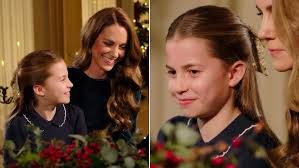
The image of Princess Kate and Princess Charlotte at the piano will likely linger long after the decorations come down. It captured a fleeting yet powerful truth — that love is often most visible not in grand declarations, but in small, shared moments. A hand on a shoulder. A melody played together. A mother and daughter, side by side, creating something quietly beautiful.
In the end, the Christmas Eve broadcast succeeded not because it was royal, but because it was human. It reminded viewers that amid tradition, titles and televised ceremonies, the heart of the season remains unchanged. Love, presence and compassion, offered gently and sincerely, still have the power to bring people together.